A flat battery is one of the most common causes of car troubles, and it always seems to happen at the worst time — when you’re rushing to work, heading off on a weekend trip, or parked somewhere inconvenient. Knowing how to charge a flat battery safely and correctly can save you time, money, and stress, and can also help you avoid damage to your vehicle’s electrical system.
In this comprehensive guide, we’ll explain why batteries go flat, the different methods to recharge them, the tools you need, step-by-step charging instructions, and safety precautions to follow. Whether you’re dealing with a flat car battery, motorcycle battery, or a 4WD starting battery, this guide will give you everything you need to know.
Why Does a Car Battery Go Flat?
Understanding why your battery has gone flat helps prevent future problems. Common causes include:
- Leaving lights or accessories on: Headlights, cabin lights, or even a boot light can drain a battery overnight.
- Parasitic drain: Some systems (alarms, dash cams, trackers, faulty control modules) draw power even when the car is off.
- Short trips: Regular short drives may not give the alternator enough time to recharge the battery.
- Old or failing battery: Most car batteries last around 3–4 years in Australian conditions.
- Extreme temperatures: Both cold snaps and hot summers can reduce battery performance and lifespan.
- Faulty alternator or charging system: If the alternator isn’t charging the battery properly, it will go flat quickly.
If your battery goes flat more than once, it’s worth having it tested by a professional battery service to identify the root cause.
Can You Recharge a Flat Battery?
Yes — in many cases, a flat battery can be recharged if it’s not completely damaged. However, the method you use depends on:
- How flat it is: A battery that’s mildly discharged (11–12 volts) can usually be charged easily. A deeply discharged or completely dead battery (<10 volts) may require a slow, controlled recharge or may not recover at all.
- If your battery is below 6v your charger and jump-start pack will not work. Due to Australian Standards they are not allowed to power any battery which is below 6v. Your battery can still be charged but it’s best to contact one of the professionals at Batteries Sunshine Coast to charge the battery safely.
- Battery type: Lead-acid (flooded), AGM (Absorbent Glass Mat), EFB (Enhanced Flooded Battery), and LiFePO4 (Lithium) batteries have different charging requirements.
- Available equipment: Do you have a battery charger, jumper leads, or access to roadside assistance?
Battery Basics and Safety Hazards
Most car batteries are sealed 12 V lead–acid units. They contain sulphuric acid and emit hydrogen gas when charging, which is extremely flammable. To stay safe: always work in a ventilated area (avoid enclosed garages), keep sparks and flames well away, and wear eye protection and acid-resistant gloves. Remove any metal jewellery (rings, watches) that could short the battery terminals. If you notice cracks or leaks in the battery casing, do not attempt to charge it – a damaged battery should be replaced and recycled properly.
Lead–acid batteries can deliver very high current if shorted, and spills of electrolyte are very corrosive. Even sitting idle, a charged battery can emit hydrogen. Keep the battery on a non-conductive surface (wood or plastic) and make sure nothing conductive (tools, coins, keys) touches both terminals. In short, prepare your workspace before beginning: no smoking, no lit cigarettes, soldering irons or grill flames, and ensure good airflow around the battery.
Tools and Preparation
Before charging a flat car battery, proper preparation ensures safety and better charging efficiency. Here’s what you’ll need and how to set up:
Tools and Equipment You May Need
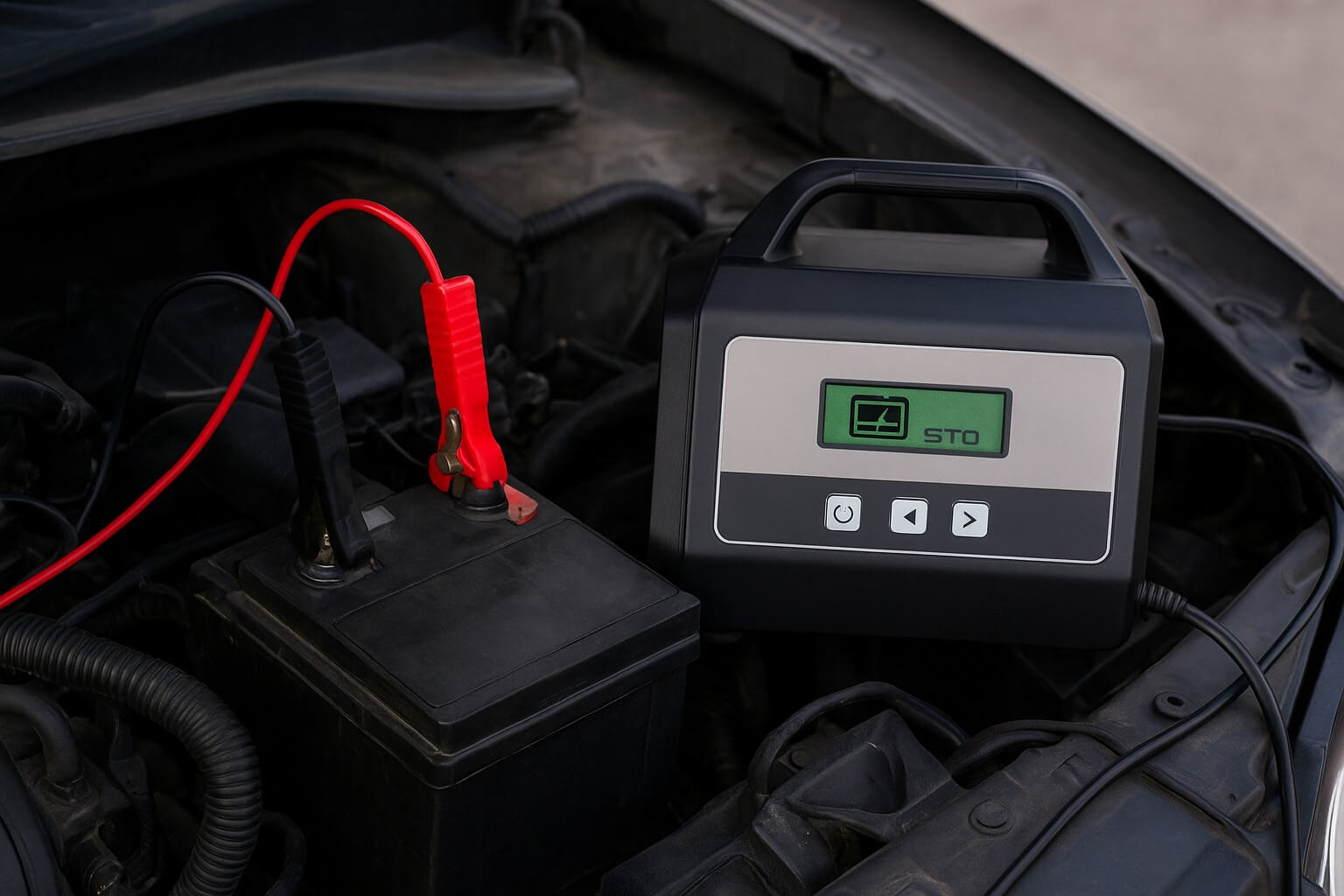
- Battery charger – A smart (automatic) or trickle charger is best for flat batteries.
- Jumper leads – Only if you’re jump-starting with another vehicle or donor battery if your battery is below 6v.
- Multimeter – To measure battery voltage and confirm charge level.
- Safety gloves and eye protection – To protect from sparks or acid splashes.
- Spanner or socket set – For loosening and removing battery cables if needed.
- Battery terminal cleaner or wire brush – To remove corrosion for a better connection.
Preparation Steps
- Disconnect the battery (if required):
With the ignition off and keys removed, open the bonnet. Loosen and remove the negative (–) cable first, then the positive (+). If removal is straightforward, lift the battery out and place it on a flat, stable surface. Charging outside the vehicle reduces risks to the car’s electronics. - Inspect the battery:
Look for cracks, bulges, or leaks. Clean the terminals of dirt and corrosion using a wire brush or terminal cleaner. If the battery shows severe corrosion, swelling, or leaks, it’s safer to replace rather than charge. - Confirm battery type and voltage:
Most car batteries are 12 V lead-acid or AGM. Some vehicles use calcium-calcium or enhanced flooded batteries (EFB). Always check your vehicle’s manual or battery label. Different chemistries require different charging modes. - Select a suitable charger:
Choose a charger that matches your battery’s chemistry and is certified for use in Australia (look for the RCM or Australian Standards mark). As a general rule, a charger with an output equal to around 10% of the battery’s amp-hour (Ah) rating works well — e.g. a 6 A charger for a 60 Ah battery. - Prepare a safe charging area:
Charge in a well-ventilated, non-flammable space away from sparks, flames, and children or pets.
Methods to Charge a Flat Battery
There are three main ways to recharge a flat battery:
1. Using a Battery Charger
This is the safest and most controlled method. A smart battery charger monitors voltage and automatically adjusts charging rates. Ideal for cars left unused for a while.
2. Jump-Starting with Another Vehicle
Useful when you need to get going immediately. This involves using jumper leads to connect your flat battery to another vehicle’s good battery.
3. Push-Start (Manual Cars Only)
For manual transmission vehicles, you can sometimes start the engine by pushing the car and releasing the clutch in 1st or 2nd gear. This is not recommended for modern cars with complex electronics.
How to Charge a Flat Battery: Step-by-Step Using a Charger
Charging a flat battery with a dedicated charger is the safest and most effective method. Follow these steps carefully:
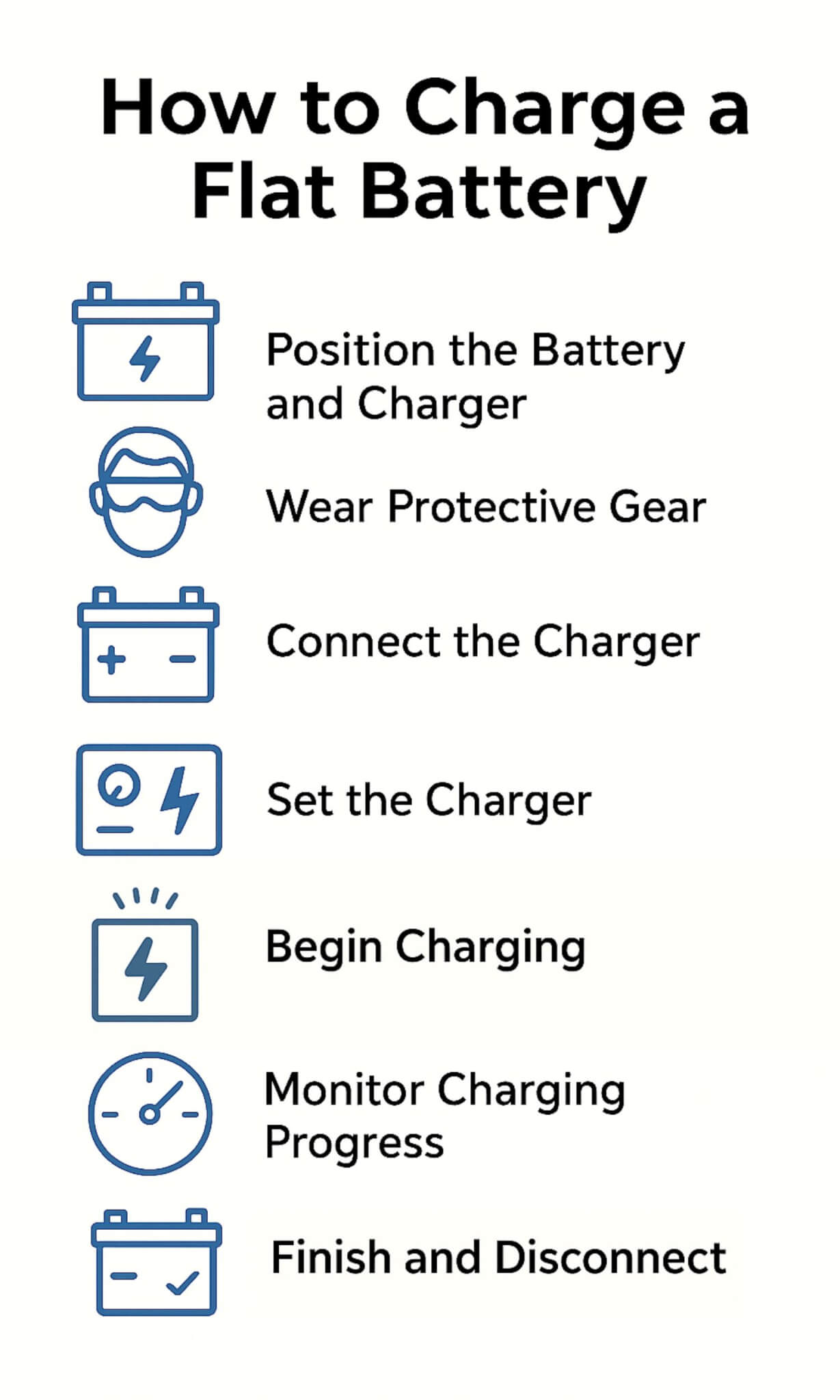
Step 1: Position the Battery and Charger
- If you’ve removed the battery, place it on a stable, non-flammable surface.
- If charging in the vehicle, park on level ground, engage the handbrake, and open windows or doors for ventilation.
- Turn off all accessories (lights, radio, fans) and ensure the ignition is off.
Step 2: Wear Protective Gear
Put on safety glasses and acid-resistant gloves. Keep children, pets, and flammable materials away.
Step 3: Connect the Charger (While Powered Off)
- Attach the positive (red) clamp to the positive (+) terminal.
- Attach the negative (black) clamp to the negative (–) terminal, or to a grounded metal part of the chassis if recommended by your vehicle’s manual (reduces spark risk near the battery).
Step 4: Set the Charger
- Ensure the charger is suitable for 12 V lead-acid, AGM, or calcium batteries (depending on yours).
- Select a moderate charging rate (2–10 A) — lower rates (trickle charging) are safer for flat batteries.
- Automatic chargers will adjust settings and switch to float/maintenance mode when nearly full.
Step 5: Begin Charging
- Plug in the charger to mains power and switch it on.
- Monitor the process — slight bubbling inside the battery is normal as gases form.
- Avoid moving clamps during charging.
Step 6: Monitor Charging Progress
- A smart charger may display charging levels.
- A fully charged battery typically reads 12.6–12.8 V at rest.
- Charging a flat car battery with a standard charger may take 4-40 hours depending on the charger size.
Step 7: Finish and Disconnect
- When charging is complete, turn off the charger and unplug it.
- Disconnect clamps in reverse order: negative (black) first, then positive (red).
- If you removed the battery, reinstall it in the car and reconnect cables: positive first, then negative.
Step 8: Test the Battery
- Start the car. If it cranks normally and holds charge, your battery is ready.
- If it struggles or goes flat again soon, it may need replacement or further testing.
How to Jump-Start a Flat Car Battery
If you don’t have a charger, jump-starting is the quickest way to get your car moving, but it requires another vehicle with a healthy battery.

Step 1: Position Vehicles
Park the working vehicle close to your car without touching it.
Step 2: Turn Everything Off
Both vehicles should have engines off and accessories turned off.
Step 3: Connect Jumper Leads
- Red lead: Flat battery positive (+) → Good battery positive (+)
- Black lead: Good battery negative (–) → A clean, unpainted metal surface on your car (not the flat battery negative terminal)
Step 4: Start the Working Vehicle
Run it for a few minutes to provide charge.
Step 5: Start Your Car
Try starting your car. If it doesn’t crank after a few tries, stop — the battery may be too discharged.
Step 6: Remove Leads Safely
Reverse the order of connection when removing.
Step 7: Keep the Engine Running
Drive for at least 20–30 minutes to allow the alternator to recharge the battery.
After Charging and Ongoing Care
Once the battery is fully charged, test that your car starts normally. If the battery still won’t hold charge or repeatedly goes flat, it may be failing or sulfated and should be replaced. In that case, have the vehicle’s charging system (alternator/regulator) checked too.
To prolong battery life in the future, avoid letting it stay discharged. If you store a vehicle long-term, use a battery maintainer or disconnect the battery to prevent parasitic drains. Periodically cleaning the terminals and checking the charge (with a voltmeter or battery tester) helps catch issues early.
Always handle batteries with care: if at any point the battery case is broken, acid is leaking, or the battery still smells foul after charging, stop and consult a professional. Lead acid batteries contain toxic materials; Australian guidelines require strict handling and battery recycling. Do not throw a spent car battery in the garbage or curbside recycling. In Australia, return your old battery to a battery retailer, service centre or council facility for safe recycling.
Australian Standards and Safety Practices
In Australia, electrical safety regulations apply to battery charging equipment. A charger intended for vehicle batteries must comply with AS/NZS 60335.2.29 (Household and similar electrical appliances – Safety – Particular requirements for battery chargers). When buying a charger, look for the RCM (Regulatory Compliance Mark) indicating it meets national safety standards. Additionally, Safe Work authorities emphasise general precautions with lead-acid batteries: always store and charge batteries in a cool, well-ventilated area and never near sparks or open flames.
Personal protective equipment is a must. Battery acid burns can be serious; always wear eye protection and gloves. Keep an eyewash or plenty of water nearby in case of accidental acid contact. After charging, wipe any spilled electrolyte with a baking soda solution (to neutralise acid) and rinse with water, then dry the area.
Finally, if you ever feel uncertain about charging a flat battery, it’s safest to get professional assistance. Many automotive service shops and battery specialists offer charging and testing as a service. Charging a car battery can be dangerous if done incorrectly. Taking the time to do it right — with proper equipment and precautions — ensures the battery is charged safely and correctly.
Safety Precautions When Charging a Flat Battery
- Wear safety gear: Acid splashes and sparks can cause injury.
- Avoid open flames or smoking: Batteries produce flammable gases.
- Check battery type: Lithium batteries require specific chargers.
- Don’t rush charging: Fast charging can overheat or damage a battery.
- Inspect for damage: Swollen or leaking batteries should not be charged — replace them instead.
How Long Does It Take to Charge a Flat Car Battery?
- With a smart charger: 4– 40 hours depending on capacity and state of charge.
- After a jump-start (via alternator): At least 30-60 minutes of driving may restore basic charge, but a deep recharge is still needed.
- With a trickle charger: Up to 48-52 hours for a very flat battery.
When Should You Replace Instead of Recharge?
Charging is only worthwhile if the battery can still hold a charge. Replace the battery if:
- It’s more than 3–4 years old and frequently goes flat.
- It fails a professional load test.
- It has visible damage (bulging, leaking, or corroded casing).
- It goes flat quickly even after a full recharge.
Preventing a Flat Battery in the Future
- Turn off lights and accessories when parked.
- Take longer drives occasionally to allow proper alternator charging.
- Use a smart charger or battery maintainer if your car is stored for long periods.
- Have your battery tested annually, especially before winter or long trips.
Final Thoughts
Knowing how to charge a flat battery safely and correctly is a skill every driver in Australia should have. Whether you use a smart charger for a slow, controlled recharge or perform a quick jump-start to get back on the road, following the right steps protects your battery and vehicle’s electronics.
If you find your battery goes flat often or struggles to hold charge, it may be time for a replacement or a full battery health check. Professional services like Batteries Sunshine Coast can test, charge, or replace your car battery — even at your home or workplace — so you can get back on the road quickly and with confidence.